Background
In the context of African political struggles during the late 20th century, the rise of the Somali National Movement (SNM) emerged as a significant chapter. This political and military movement was catalyzed by the oppressive nature of President Siad Barre’s government, which had entrenched itself in Somalia by the 1980s. Barre’s regime was notorious for its authoritarian governance, characterized by political repression, widespread corruption, and the systematic marginalization of specific ethnic groups, among whom the Isaaq clan was a primary target. Located primarily in the northern regions of Somalia, the Isaaq clan found itself at the brunt of this marginalization, leading to growing dissent and unrest among its members.
The establishment of the SNM was neither an isolated incident nor merely a reaction to local grievances. Instead, it was a manifestation of a broader call for resistance against a regime that had increasingly alienated its populace. The movement capitalized on existing frustrations, consolidating its efforts to not only oppose Barre’s rule but also to achieve a more self-governing status for the northern regions, addressing a longstanding aspiration for autonomy.
Foundation and Aims
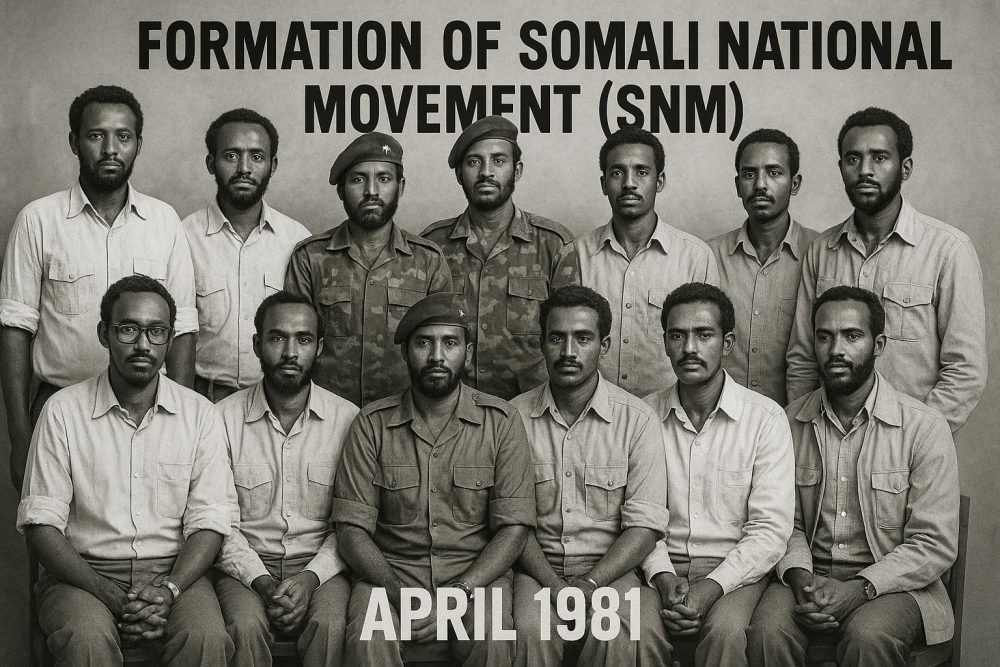
The foundation of the SNM in London on April 6, 1981, marked a significant turning point in Somali politics. Its founders, primarily Somali expatriates from the Isaaq community, were driven by a collective realization of their marginalized status within the national framework. This group of expatriates leveraged their overseas connection to initiate a movement that would not only channel the discontent of the Isaaq people but also strive to dismantle Barre’s authoritarian government.
The articulated aims of the SNM went beyond mere opposition. The movement aspired to establish a government rooted in democratic principles, ensuring that the injustices and inequalities faced by their communities were adequately addressed. Such a vision was embedded in their broader goal of transforming Somalia from an authoritarian state into a nation where power was equitably distributed and governance was subjected to the will of its people.
Initial Challenges
Establishing and sustaining a resistance movement against an entrenched regime was fraught with challenges. The SNM, particularly during its infancy, encountered significant logistical and operational difficulties. One major obstacle was the lack of resources which hampered their ability to execute widespread operations effectively. The vast geographical dispersion of their supporters further compounded the complexity of organizing cohesive actions, as maintaining consistent communication with all factions of the movement proved challenging.
The heavy-handed repression by Barre’s administration added another layer of complexity. The Somali government employed stringent measures to suppress dissent, rendering the operational environment perilous for SNM members, both domestically and internationally. This oppressive context necessitated the adoption of covert methods of operation, as open dissent was often met with swift and brutal retaliation.
Military Strategy
To counter these hurdles, the SNM devised a military strategy rooted in guerrilla tactics, which would eventually become one of their defining characteristics. Their choice to establish operations along the Somali-Ethiopian border was strategic, allowing them to recruit fighters and gather arms away from the direct reach of the government. This location also facilitated Ethiopia’s involvement, providing logistical and, occasionally, direct military support.
Utilizing guerrilla warfare, the SNM executed surprise attacks and raids on government installations, inflicting significant damage while evading larger conventional forces. This asymmetric warfare allowed the SNM to continuously harass Barre’s forces, undermining their morale and depleting their resources without engaging in large-scale confrontations, which would likely have been disadvantageous given the disparity in numbers and equipment.
Regional Influence
The activities of the SNM transcended local dynamics, having implications that rippled across the Horn of Africa. Ethiopia’s involvement underscored the movement’s regional significance, as it aligned with Ethiopia’s interest in destabilizing Barre’s government, a regime that had been perceived as antagonistic. Ethnic ties across borders, along with geopolitical interests, meant that the SNM’s actions were inevitably entangled with broader regional politics.
However, despite these entanglements, the SNM maintained a focused commitment to its primary objective: weakening Barre’s grip over northern Somalia. This dedication to their initial cause was instrumental in diminishing the government’s authority, setting the stage for wider political changes within the region.
Significance and Legacy
The SNM’s sustained efforts were a pivotal factor in the eventual downfall of Siad Barre’s regime in 1991, leading to a period of profound transition within Somalia. The SNM’s accomplishments in northern Somalia contributed significantly to the self-declaration of Somaliland as an independent entity, marking a shift towards regional autonomy, albeit without formal international recognition.
Despite this lack of recognition, Somaliland has distinguished itself as a region of relative peace and stability, in stark contrast to many parts of Somalia that have continued to grapple with insecurity and political turmoil. The legacy of the SNM is embedded in this stability, as the movement laid the foundational governance structures and fostered the political climate necessary for Somaliland’s continued autonomous functioning.
The historical significance of the SNM extends beyond the immediate political changes it catalyzed. Its existence and operations offer insights into the nature of insurgency movements, particularly in post-colonial contexts where ethnic and regional disparities played critical roles in political developments. The story of the SNM serves as a testament to the enduring struggle for self-determination and the complexities inherent in navigating the balance between national unity and regional autonomy.
For those interested in further exploring the political intricacies of Somalia during this turbulent period, detailed historical analyses of post-colonial African politics and the geopolitical dynamics in the Horn of Africa provide valuable perspectives. Such studies reveal the intricate web of causes and consequences that shaped the SNM’s formation and its enduring impact on the region’s socio-political landscape.