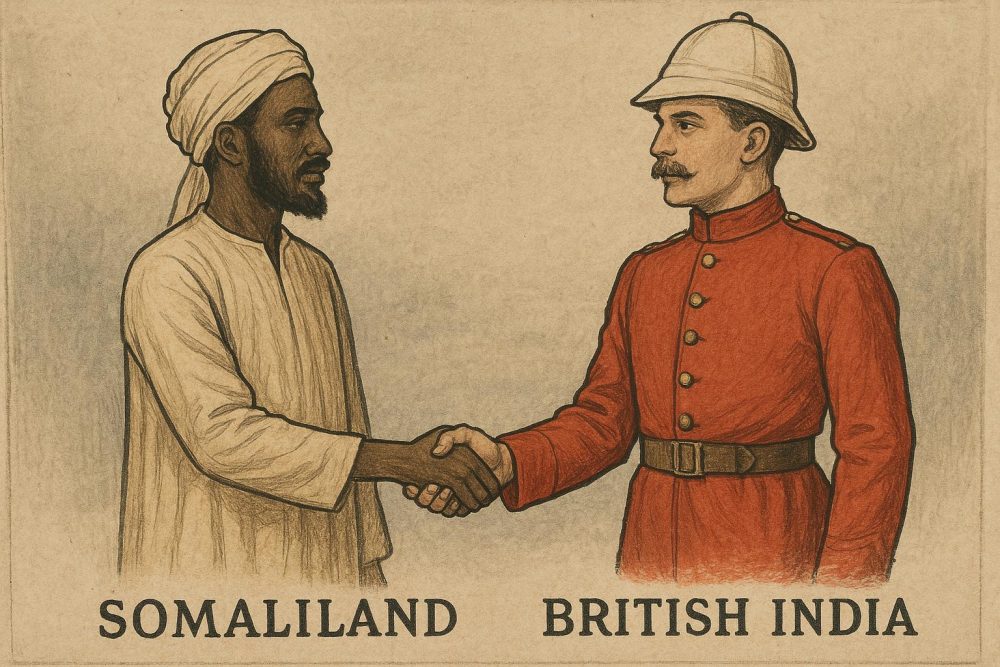
The Historical Context of Somaliland and British India
The interaction between Somaliland and British India is a rich tapestry woven during the colonial era, marked by strategic alliances and economic pursuits. The late 19th and early 20th centuries were periods of intensive colonial expansion, where major powers sought to extend their influence across the globe. The intertwining fates of Somaliland and British India during this time illuminate a complex interplay of interests that were primarily strategic and economic in nature.
Colonial Motivations and Interactions
British Somaliland emerged as a British protectorate in the late 19th century. It formed a critical part of the British colonial strategy in East Africa, a strategy principally geared towards securing and protecting trade routes to the East. The primary motivation behind these colonial pursuits was to establish control over key maritime passages, thus ensuring the uninterrupted flow of trade and resources.
The colonial administration in Somaliland leveraged the experienced bureaucratic framework of British India. British India, at the time, had developed a robust administrative system. This system was well-versed in managing colonial territories, with a fine-tuned bureaucratic mechanism that could be effectively transplanted to support British objectives in Somaliland. This mutual interaction laid the groundwork for a relationship that was vital for the success of British colonial policies in the region.
Economic and Strategic Interests
The economic motivations underpinning British expansion into Somaliland were significant. Somaliland occupied a strategic geographical position along the Gulf of Aden, a crucial point for controlling maritime routes. The region’s economic value was perceived through its potential to enhance trade security and accessibility. This importance was further amplified by the pre-existing administrative expertise found in British India.
British India’s administration had developed significant experience in colonial management, which proved instrumental for Somaliland’s governance. The personnel dispatched from British India not only carried with them expertise but also resources necessary to establish and stabilize administrative operations in Somaliland. Such resources included trained officials, administrative frameworks, and infrastructure support, all of which were pivotal in setting up effective governance structures.
Cultural Exchanges and Administration
The movement of personnel from British India to Somaliland facilitated significant cultural exchanges. These exchanges brought about a fusion of administrative skills and cultural influences, which left a profound impact on governance structures, legal systems, and day-to-day activities within Somaliland. Judicial practices, bureaucratic processes, and administrative operations in Somaliland frequently mirrored those of British India. This overlap was a testament to the influence wielded by British India’s well-established administrative systems over the protectorate.
Beyond administration, cultural practices and traditions also seeped into daily life, manifesting in varied forms across different social practices and community engagements. The cultural exchange during this period was not merely a byproduct of colonial administration but a deliberate integration designed to enhance the efficiency of governance and facilitate smoother administrative operations.
Military Collaborations
Military collaboration formed another critical pillar of the relationship between Somaliland and British India. The significance of maintaining security in both regions was paramount. British India, possessing a robust and disciplined military force, supplemented Somaliland’s defense mechanisms.
Soldiers from British India were occasionally deployed in Somaliland, tasked with maintaining order and defending against regional conflicts and insurgencies. This military presence was crucial for safeguarding British colonial interests, ensuring that peace and stability were upheld in a strategically vital region.
Legacy of the Relationship
The historical relationship between Somaliland and British India has left an indelible legacy that extends into the present day. The administrative practices instituted during the colonial period left a lasting impression, influencing governance structures and legal frameworks long after the period of decolonization. The echoes of this relationship are still palpable, discernible in the infrastructure, administrative methodologies, and even legal systems operational in modern-day Somaliland.
Infrastructure developed during the colonial era, much of it inspired by British India’s administrative practices, continues to form the backbone of Somaliland’s public amenities and government services. These lasting impacts highlight the enduring significance of the colonial interactions between Somaliland and British India, continuously shaping the socio-political landscape well beyond the end of colonial rule.
Conclusion
In essence, while the primary drivers of the relationship between Somaliland and British India were anchored in colonial motivations, the far-reaching interactions that ensued laid the groundwork for enduring administrative and cultural ties. An exploration into this intertwined history provides valuable insights into the historical dynamics that have significantly shaped contemporary Somaliland.
For those interested in further exploring the colonial history of Somaliland, a wealth of scholarly articles and historical archives awaits, offering deeper insights into this fascinating period and illustrating the intricate connections forged during a pivotal era in global history.