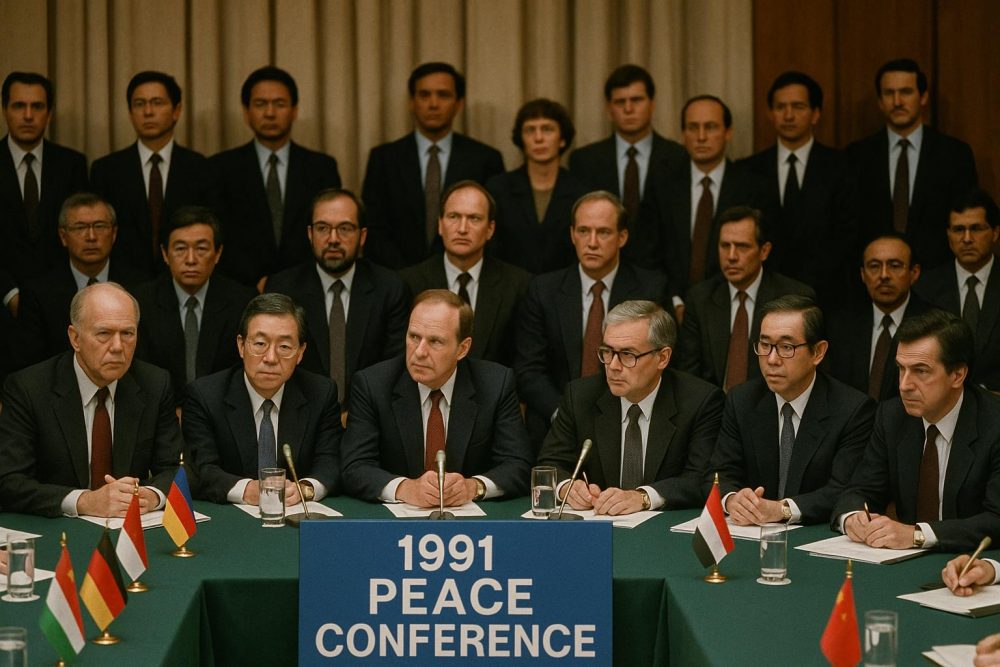
The Madrid Conference of 1991
The 1991 Madrid Peace Conference symbolizes a critical juncture in the complex peace process of the Middle East. Hosted in the historic city of Madrid, Spain, the conference was a prominent diplomatic event co-sponsored by two major global powers at the time: the United States and the Soviet Union. The primary aim of this gathering was to set the stage for comprehensive negotiations involving various key stakeholders in the long-standing Arab-Israeli conflict. By bringing multiple parties to the negotiation table, the conference sought to address deep-seated tensions and foster pathways towards sustainable peace.
Background and Objectives
Taking place in a post-Gulf War context, the Madrid Conference was not merely a spontaneous occurrence but rather a carefully planned diplomatic effort. The dynamics of the Middle East had significantly shifted after the Gulf War, creating a window of opportunity that the sponsors of the conference were keen to exploit. The main objective was straightforward: to initiate direct negotiations between Israel and its neighboring Arab nations. This initiative included an essential focus on facilitating specific peace talks between Israel and the Palestinians, thereby acknowledging the unique and pressing nature of the Israeli-Palestinian disputations.
The post-war environment offered a rare opportunity to shift the regional geopolitics towards a more peaceful paradigm. With the Soviet Union winding down its global influence and the United States emerging as a dominant power, there was a shared interest in stabilizing the Middle East, a region critical to both superpowers. The conference was thus designed to harness this geopolitical momentum and steer it towards meaningful dialogue.
Key Participants
A diverse group of participants gathered in Madrid, each with its unique interests and grievances. Among the notable participants were Israel, along with Syria, Lebanon, Jordan, and the Palestinian delegation. The Palestinian representatives were part of a joint delegation with Jordan, reflecting the complex political landscapes and alliances of the time. This assembly was noteworthy for several reasons, chief among them being that it marked the first occasion where many of these parties engaged in face-to-face discussions aimed at peace.
On the diplomatic front, the United States, under the leadership of President George H.W. Bush and Secretary of State James Baker, was instrumental in orchestrating the dialogue. The involvement of the Soviet Union added a layer of credibility and balance, signaling to the Arab states that their concerns would be taken seriously and that the process was genuinely international in scope. The involvement of these superpowers was important, not only for their mediating roles but also for the political and economic leverage they could exert to encourage compromise and progression.
Structure and Approach
The structure of the Madrid Conference was designed with both flexibility and comprehensiveness in mind. It featured both bilateral talks and multilateral discussions, recognizing that different aspects of the conflict required different approaches. Bilateral talks allowed Israel and its neighboring states or entities to address their unique bilateral disputes directly, such as border issues and security concerns.
In contrast, the multilateral discussions were geared towards broader questions that transcended individual country concerns. These included matters like water resource management—a critical issue given the arid nature of much of the Middle East—economic cooperation, and arms control. By adopting this dual approach, the organizers envisaged creating a holistic framework that could support and underpin a lasting peace in the region.
Outcomes and Challenges
While the Madrid Conference did not result in any immediate, binding agreements, it was successful in other meaningful ways. Perhaps its most significant achievement was establishing a precedent for ongoing negotiations. By opening up channels of communication between parties previously locked in adversarial relations, the conference laid the foundation for future peace efforts. Subsequent initiatives, such as the Oslo Accords, undoubtedly benefitted from the groundwork laid in Madrid.
Nonetheless, the road to peace proved to be fraught with challenges. There were significant differences in expectations among the parties, each of whom came to the table with different visions of what a peace process should entail and achieve. The complexity of the issues at hand—ranging from territorial disputes to the status of refugees—presented formidable hurdles. Despite these challenges, the Madrid Conference is recognized as a crucial step in the ongoing quest for peace in one of the world’s most volatile regions.
Legacy and Impact
The legacy of the 1991 Madrid Peace Conference is both profound and enduring. In the years following the conference, its impact was felt through a series of further negotiations and agreements. It served as a testament to the potential of diplomatic engagement as a tool for resolving deep-rooted conflicts. Even in the barracaded and divided landscape of the Middle East, the conference illustrated that dialogue and negotiation could indeed lead to meaningful progress.
The emphasis placed on direct negotiations and multilateral cooperation during the conference continues to wield significant influence over current peace processes. Today, when international actors look to mediate conflicts in the Middle East, they often refer back to the structure and strategy of the Madrid Conference as a blueprint for potential success.
In summary, the Madrid Conference of 1991 stands as a monumental milestone in Middle Eastern diplomacy. Its enduring influence is evident in the sustained efforts to foster dialogue and resolve conflicts in the region. For those interested in delving deeper into the historical and diplomatic contexts of the Middle East, there is a wealth of resources available through reputable academic institutions or dedicated government archives. These materials provide extensive insights and analyses that shed light on the complex dynamics of the region and the intricate dance of diplomacy that continues to unfold.