The Background of the Battle of Dul Madoba
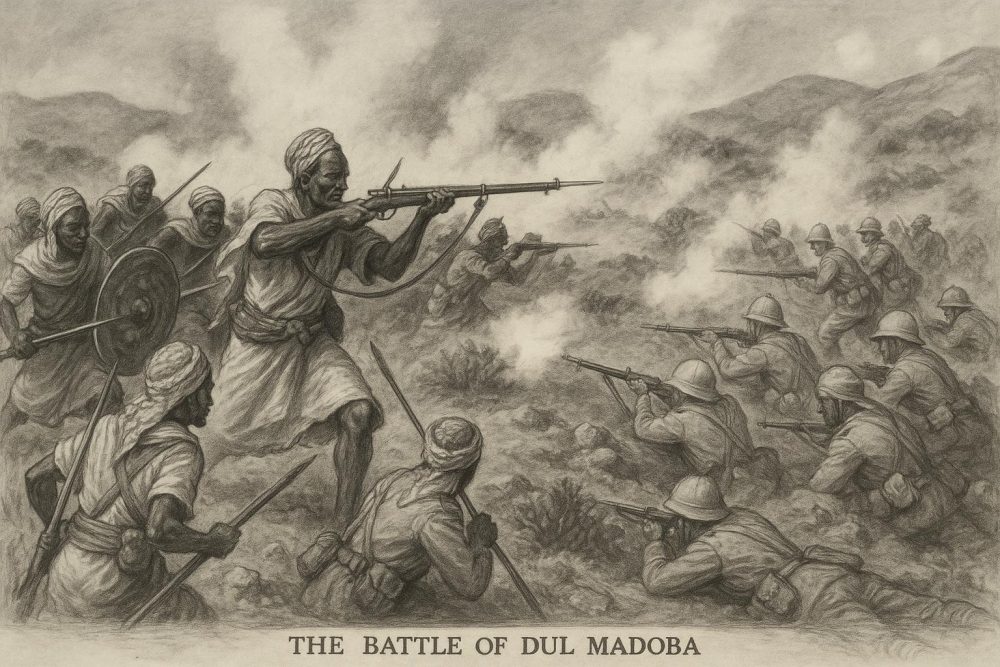
The Battle of Dul Madoba, fought on August 9, 1913, was a pivotal moment in the history of British Somaliland, underscoring the complexity of British military campaigns in the region. These efforts were directed against the resilient Dervish forces led by Mohammed Abdullah Hassan, a Somali religious figure labeled the “Mad Mullah” by British colonials. This conflict was part of a larger pattern of resistance by the Dervishes against British, Italian, and Ethiopian incursion in the region. Through the lens of this singular battle, the persistent and determined efforts to resist colonial control are made evident. Understanding the nuances of such historical conflicts requires a deep dive into geographical, strategic, and socio-political dimensions that influenced them.
Location and Strategic Importance
Situated in the mountainous expanses of Somaliland, Dul Madoba provided a terrain replete with both obstacles and tactical opportunities for the belligerents. The rugged geography of the region was instrumental in shaping the strategies of both the British forces and the Dervish fighters. Mountains and elevations offered commanding views and defensive positions essential for military advantage. To fully comprehend the battle’s significance, one must consider the strategic imperatives of such high ground. The British aimed to assert control over the terrain to suppress the Dervish, while the latter sought to leverage it to maintain their resistance.
The Combatants
In examining the forces that clashed at Dul Madoba, the asymmetry in size and tactics is readily apparent. The British contingent, mainly comprising the Somaliland Camel Corps, was under the command of Lieutenant Colonel Richard Corfield. With his small force of approximately 110 men, Corfield’s command faced daunting odds. In stark contrast, the Dervish fighters not only possessed a significant numerical advantage but also intimate knowledge of the terrain, having lived and fought in it for years. Their familiarity allowed them to apply guerrilla tactics adeptly, striking swiftly and then vanishing into the landscape. Such expertise represented a formidable challenge to the British forces, who were encumbered by conventional military strategies ill-suited to the environment.
The Course of the Battle
The unfolding of events during the battle reveals much about the tactical decisions on both sides. The British forces initiated a forward movement into the Dul Madoba region, a tactical maneuver intended to confront and neutralize the Dervish resistance. However, almost immediately, the British troops came under heavy and unrelenting attack. The Dervishes’ strategic use of the terrain allowed for sudden assaults that capitalized on their intimate knowledge of the local geography. As conflicts erupted, the British found themselves enmeshed in a battle against both a determined enemy and the harsh environmental conditions. The correlation between the topography and the Dervishes’ successful execution of guerrilla strategies highlights the challenges faced by colonizing forces attempting to operate in unfamiliar and difficult terrains.
The battle intensified, placing the British in an untenable position; they were effectively outflanked and besieged. The Dervishes, with their superior numbers and tactical prowess, delivered a crushing blow, leading to substantial British casualties. The death of Lieutenant Colonel Corfield marked a turning point in the conflict, severely impacting the morale and operational capabilities of his contingent. Leadership in such engagements is crucial, and Corfield’s loss exemplified the weight of command responsibilities in colonial military expeditions.
The Aftermath
The outcome of this encounter at Dul Madoba was nothing short of a decisive Dervish victory. The British losses were severe, underlining the harsh realities of waging war in the challenging topography of Somaliland. The engagement had profound implications, not only diminishing British operational strength but also amplifying the resolve of the Dervish fighters. Such victories served to embolden the Dervish spirit, reinforcing their campaign against foreign domination.
This battle was emblematic of the broader contemporary struggle of colonial powers grappling with local resistance across the Horn of Africa. The enduring struggle led by Mohammed Abdullah Hassan against colonial invasion reflected a larger geo-political tension between indigenous sovereignty and colonial ambitions. His leadership in rallying diverse Somali communities against external forces emphasized the deep-seated opposition to colonial governance.
The analysis of the Battle of Dul Madoba offers insight into the complexities faced by colonial forces in regions characterized by difficult terrain and robust resistance. A clear understanding of these dynamics requires further exploration into military history, with a focus on the colonial period of the Horn of Africa. For those interested in delving deeper into the historical context, numerous well-researched military history sources and archival records can provide additional comprehensive perspectives on the events surrounding the battle.