The Introduction of Sufism in Somaliland
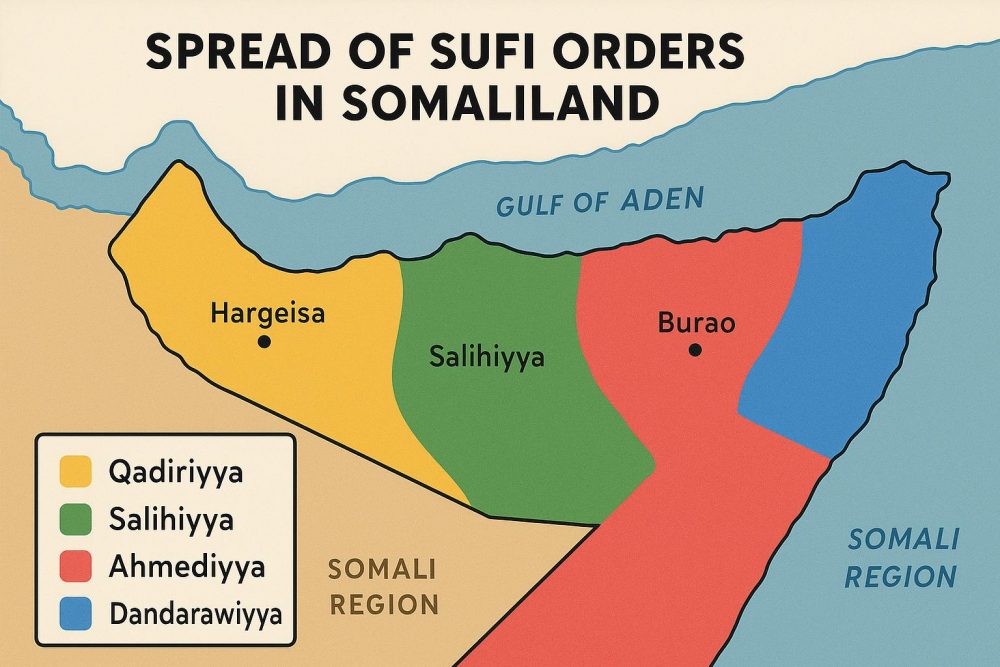
The spread of Sufi orders in Somaliland forms an essential tapestry of the region’s rich cultural and religious history. Known for its mystical and spiritual approach to the practice of Islam, Sufism was introduced to the Horn of Africa primarily by Muslim traders and scholars. Over the centuries, it has had an indelible impact on both the religious practices and the social structures of Somaliland.
The Role of Trade in the Spread of Sufi Orders
The strategic geographical positioning of Somaliland along the Red Sea has historically facilitated a network of extensive trade routes linking the Middle East, Africa, and Asia. This trade network was more than a conduit for goods; it was a bridge for exchanging religious, cultural, and intellectual ideas. Muslim traders sailing these waters were not only merchants of material commodities but also harbingers of Islamic traditions, including the diverse teachings of Sufism. Through their interactions, they laid the groundwork for embedding Sufi traditions into the local cultural fabric.
The exchanges between these traders and the indigenous populations often went beyond commercial and culminated in cross-cultural exchanges that had lasting spiritual implications. As traders settled or frequently visited these coastal communities, they fostered the growth of Sufi orders by introducing and practicing Sufi rituals and festivities, thus cementing Sufism’s foothold in local communities.
Migrations of Sufi Scholars
Another significant avenue through which Sufism found its way into Somaliland is the migration of Sufi scholars from the Arabian Peninsula and surrounding regions. These scholars, often fleeing political unrest or inspired by spiritual missions, journeyed to Somaliland with the intent of spreading their mystical understanding of Islam. Once settled, they engaged in education and spiritual guidance, sharing the intricacies of Sufism, which focuses heavily on the purification of the inner self and personal spiritual experiences.
By establishing ***tariqas***, or Sufi orders, these scholars created critical centers for spiritual and academic learning. These schools of thought were pivotal in not only educating the young and old about the tenets of Islam but also in immersing them in the transformative inner journey that Sufism advocates. The tariqas served as spiritual sanctuaries where the teachings of unity, love, and personal connection with the divine were handed down through generations, deeply embedding the Sufi worldview into the religious consciousness of the people.
Key Sufi Orders in Somaliland
In the spiritual landscape of Somaliland, several prominent Sufi orders have emerged, each bringing its unique interpretation and spiritual practices to the community. Notable among these are the Qadiriyya, Shadhiliyya, and Salihiyya orders, each of which has profoundly shaped the spiritual life of Somaliland.
The Qadiriyya order, perhaps one of the earliest orders to appear in the region, emphasizes inner devotion, love, and knowledge of God. The order is known for its inclusive approach, welcoming adherents from all walks of life, thereby creating a diverse yet united community of believers. On the other hand, the Shadhiliyya order is characterized by its strong sense of discipline and structured spiritual practices that are aimed at achieving personal transformation through inward contemplation and rigorous self-discipline. The Salihiyya order, meanwhile, is recognized for its stress on direct connection and personal communion with God, valuing experiential knowledge over theoretical understanding.
Together, these orders have created a multifaceted spiritual environment that caters to varied individual spiritual needs, thus fostering an adaptable and deeply rooted sense of spirituality.
Community Involvement and Influence
Beyond their spiritual teachings, Sufi orders in Somaliland have traditionally involved themselves deeply in the social and political contexts of their communities. They function not solely as religious institutions but also as vital social entities that engage actively in community building and mediating conflicts. Sufi leaders, or **sheikhs**, often step into roles as mediators for local disputes, lending their wisdom and guidance in resolving conflicts and providing counsel on moral and religious issues.
Moreover, their responsibilities extend into conducting social welfare activities, reflecting the orders’ commitment to community development. They have supported initiatives in education and healthcare, providing much-needed services that contribute to the welfare and upliftment of the broader community. It is through these activities that the influence of Sufi orders becomes multifaceted, impacting not only personal spirituality but also societal cohesion and well-being.
As Somaliland continues to face contemporary challenges and changes, the influence of Sufism remains a glowing testament to its adaptability and resilience. The orders’ focus on spiritual growth, communal harmony, and social service ensures that Sufism remains a dynamic and integral part of the region’s evolving religious landscape.
Learn more about Sufi practices and their modern implications.